Springs · Richmond Hill
Garage Door Roller Replacement
Since the cold snap the door has been stiff and noisy first thing, and after the last thaw the bottom corner began to judder. There is slush in the foot of the track and a bloom of rust on the lowest wheel.
Garage Door Roller Replacement
In plain words
Winter is hard on rollers. Slush carried in on the tires freezes in the foot of the track, wheels skid across the ice instead of turning and wear flat spots, and salt eats into steel stems and bearings at the lowest positions first. By spring a door that was merely a little noisy is juddering. Roller replacement after a hard season puts fresh wheels and bearings under the door, and the technician clears the salt from the lower track and inspects the bottom brackets and cables that share the same wet corner, so the door heads into the next winter in better shape.
How the visit goesNew springs went in last year and the door balances well, yet it still clicks along the ceiling track like a train over rail joints. The wheels are the originals, worn to an oval, and the noise follows them from one end of the travel to the other.
Richmond Hill
How the visit goes
What the winter left behind
In this climate the foot of the track is where trouble collects. Slush and salt carried in on the tires settle in the bottom few inches, freeze overnight into ridges and leave a brine that attacks steel. The technician looks for corrosion on the bottom rollers and their stems, rust on the bottom brackets, ice damage or flat spots on wheels that have been skidding rather than turning, and the state of the lifting cables that share that wet corner. Finding salt damage here steers the recommendation toward sealed-bearing rollers and a thorough track cleaning, and occasionally toward new bottom brackets as well.
The bottom rollers and the cable brackets
The lowest rollers live in the bottom brackets, and those brackets also anchor the lifting cables, which means they carry the counterbalance load whenever the door is closed. This is the one roller position that is never approached casually. Depending on the door, the technician either exchanges the roller while the bracket stays fastened and the cable stays put, or first takes the spring tension off with winding bars so the bracket can be unbolted and inspected. Either way the bracket, the cable end and the fastening into the section are examined, and a corroded or bent bracket is replaced while the door is already secured.
Hardware tightened along with the wheels
Roller replacement is a natural moment to go over the rest of the door, and you leave with more than new wheels. Every hinge fastener has been checked and snugged, loose jamb brackets have been tightened, worn hinges have been replaced with the correct numbered ones, and the top fixtures and bottom brackets have been inspected and, where corroded or bent, changed. The track has been cleared of salt and grit and squared to the door. This kind of once-over is what industry guidance means by regular service, and it is much of the reason a door feels solid again after the visit.
Garage Door Roller Replacement
In the van
- Sealed-bearing nylon rollers
- Jamb bracket fasteners
- Track clamps or locking pliers
- Three-inch rollers for commercial track
- Garage door lubricant
What affects the quote
Same fees day, night or weekend
1Hinges that need replacing
Cracked, elongated or rusted hinges found during the inspection are replaced with the correct numbered hinge, each priced as its own item alongside the rollers.
2Stem length and double hinges
Doors with two hinges stacked at each end need long-stem rollers at those positions. Those cost more than standard four-inch stems and are counted separately in the quote.
3Number of sections and rollers
A four-section door carries ten rollers and a five-section door twelve; taller doors with more sections, or doors fitted with extra rollers at the top, add to the set, and the quote follows the count.
Garage Door Roller Replacement: questions
What is the difference between nylon and steel rollers?
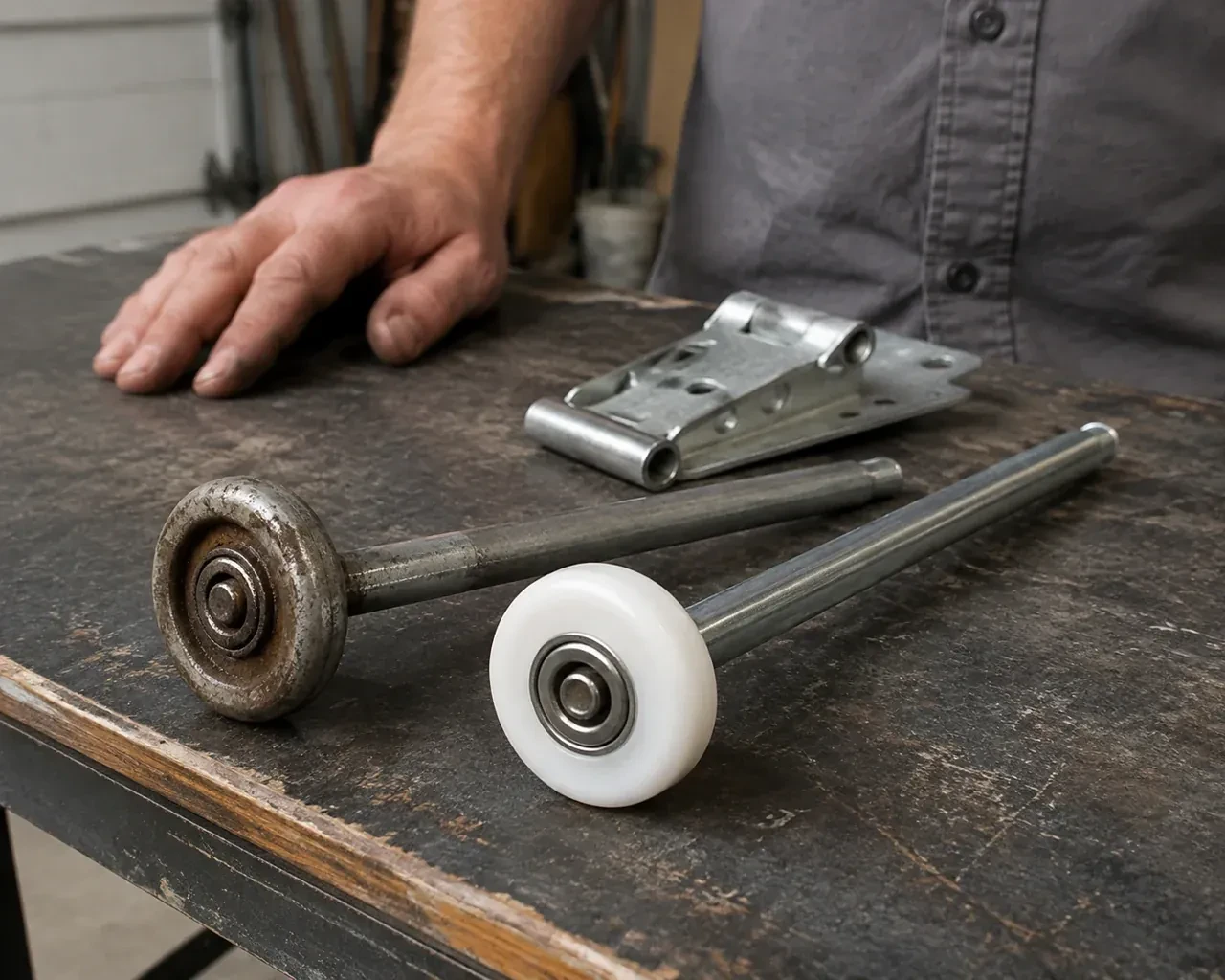
Both are a wheel on a steel stem, commonly on ball bearings though standard nylon rollers can be bearingless; the bigger difference is the wheel material. A steel wheel is tough and suits very heavy or commercial doors, but steel on a steel track is loud and grows louder as bearings wear. A nylon wheel wraps a tire around the hub, absorbing vibration rather than passing it into the track, so the door runs more quietly and the wheel never rusts. For most residential doors, nylon is the usual recommendation.
Do nylon rollers need lubricating?
The nylon tire itself needs none; spraying it or the track only collects dust that grinds the wheel. The hinge knuckles and stems where they turn benefit from a light coat of garage door lubricant once or twice a year, worked in by running the door. The ball bearings themselves are lubricated only where the roller's own maker calls for it, since some nylon rollers should not be greased there. Rollers with sealed bearings come greased from the factory and need only a wipe and a look.
Are the bottom rollers different from the rest?
The wheels themselves are usually the same, but their home is not. The bottom rollers sit in the bottom brackets, which also anchor the lifting cables and therefore carry the counterbalance load whenever the door is closed. That is why manufacturers put warning labels there and why this position is handled by a trained technician who either exchanges the roller without disturbing the bracket or relieves the spring tension first. It is also the position most exposed to salt and slush, so it is inspected with extra care.
Springs & Hardware
- Garage Door Track Repair or ReplacementBacking out this morning, the mirror caught the track beside the door.
- Garage Door Cable ReplacementStanding inside with the door closed, you notice the cable on the right side near the floor has…
- Torsion Spring ReplacementAfter pulling the red release cord, you tried lifting the door yourself and it would barely leave…
Garage Door Roller Replacement near you
Repairs, hardware, openers and new doors: those are the four kinds of garage door work we do in Richmond Hill. Most visits are repairs and tune-ups, springs and cables are the most common replacements, opener and remote problems come next, and new doors are planned with more time and care.